Getting clients
How to Get House Cleaning Clients: What Each Source Costs You
Where recurring cleaning clients come from: referrals, Google Maps, a website with prices, answered calls and realtors. How to work out what a client is worth and what you can pay to win one.
 MaidPilot8 min read
In this article
Most house cleaning clients come from people who already trust you: a neighbor a happy client mentions you to, a Google Maps listing with reviews and prices, and a phone that is answered. Shared lead sites can fill a first week, but you pay for each request whether or not it books. On the example numbers in this guide, one new biweekly client is worth about $81 a month after costs, so every way of finding clients should be judged against that figure.
This guide is for the United States. Rules on door-to-door advertising, reviews and licenses differ by city and state, so check yours. All dollar figures are round example numbers unless a link says otherwise. Replace them with yours.
What is a new client worth to you?
Use the example home from our guide on how much to charge for house cleaning: a 3 bedroom, 2 bath home cleaned every two weeks for $145.
- Sales per year: 26 visits x $145 = $3,770
- Sales per month: $3,770 / 12 = $314
- After all costs: $145 - $107.58 = $37.42 a visit, so $37.42 x 26 = $973 a year, or about $81 a month
Now decide how much you will pay to win one. A simple rule is to spend no more than three months of what the client leaves you. Three months of $81 is $243. If a lead source costs you more than that for each client it brings, you lose money until month four, and some clients leave sooner. Use this number to judge everything below.
1. Referrals from the clients you have
Your clients know people like them, in homes like theirs. Ask on purpose:
- Text every happy client a week after their third cleaning: "I am glad the home is working for you. If a neighbor or friend needs a cleaner, I will give you $25 off your next visit for each one who books a recurring plan."
- Say thank you when it happens, even if the friend does not book
- Keep a list of who sent whom
Do the arithmetic. With 20 clients, one referral a month is 12 new recurring clients a year. At $25 off each, the credits cost $300. Those 12 clients are worth $3,770 each in sales, $45,240 in all. Even if half of them leave after six months, the credits are a small cost next to that.
One rule: keep the credit separate from reviews. Google's policy says that offering incentives, like free or discounted goods or services, in exchange for customers to post reviews is prohibited. A credit for bringing a new client is a referral. A credit for writing a review is not allowed on Google.
2. Google Maps and your Business Profile
When someone types "house cleaning near me", the map with three companies shows up first. Google says local results are based on three things: relevance is how well a Business Profile matches what someone is searching for, distance refers to how far each business is from the customer who's searching, and prominence means how well-known a business is. You cannot change distance. You can work on the other two.
- Relevance: pick the cleaning categories that match what you sell, and fill in every field: services, service area, hours, photos
- Prominence: Google says that more reviews and positive ratings can help your business's local ranking. Ask for a review after every cleaning (see below)
- Your home address: Google's guidelines say that if you're a service-area business, you should hide your business address from customers. Most cleaners work from home, so check this setting
- Your name: Google's guidelines say that your name should reflect your business's real-world name, as used consistently on your storefront. Do not stuff keywords into it
To ask for a review, Google says that you can ask customers to visit a Google link or scan a QR code. Send the link by text from the invoice, when the home still looks its best. Never write reviews yourself or ask for only the good ones: the FTC says that the rule prohibits businesses from implying that a review has to be positive, and that the rule authorizes courts to impose civil penalties for knowing violations.
Our guides on your Google Business Profile and getting more Google reviews go step by step.
3. A website that shows prices
People who search "house cleaning prices" want a number before they call. A page with your prices by bedrooms, your weekly and biweekly plans and a form for the address turns a visitor at 9 p.m. into a booked visit while you sleep. See what a house cleaning website should have, and how the estimate calculator quotes a home without a walkthrough.
4. Answer every call, fast
People call two or three cleaners and book the first one that answers with a price. Count your missed calls for a week. Suppose you miss 5 a week and one in five would have become a biweekly client. That is one client a week, and four clients in four weeks, each worth $314 a month in sales and $81 after costs: $1,256 and $324 a month. These numbers are made up to show the sum; your phone shows the real count. A missed-call text, a receptionist or a partner who picks up the phone can all fix this. See what missed calls cost a cleaning business.
5. Lead sites: work out the price before you buy
A lead site sells you a request from someone looking for a cleaner. The price per lead differs by site and by city, so we do not quote one. Ask the site in writing:
- What does one lead cost in my town?
- How many companies receive the same request?
- What is your refund rule when the caller never answers?
Then do the sum. If you pay $20 a lead and 1 lead in 10 becomes a recurring client, each client costs $200. That is under the $243 limit, so it is acceptable on these numbers. If you pay $40 a lead with the same close rate, each client costs $400, and you lose money for the first five months. Track the real close rate for a month before you spend more. Leads usually ask for the lowest one-time price, so the close rate to recurring plans is the number to watch.
6. Nextdoor and neighbors
Neighbors ask "can anyone recommend a cleaner?" every week. Ask your clients to tag you when they see those posts, and answer the same day. Post your own before and after photos with the neighborhood name sometimes, with the client's permission. Keep it helpful, not salesy, and read the group's rules first.
7. Realtors and property managers
Move-in and move-out cleanings come from people who change homes. Visit three local real estate offices and three property managers with a one-page card: your move-out prices, your insurance, your phone. Price the job with the method in our guide on deep cleaning and move-out cleaning prices. One property manager who sends two move-outs a month is 24 jobs a year, and each one is a chance at a recurring client.
8. Door hangers on your best street
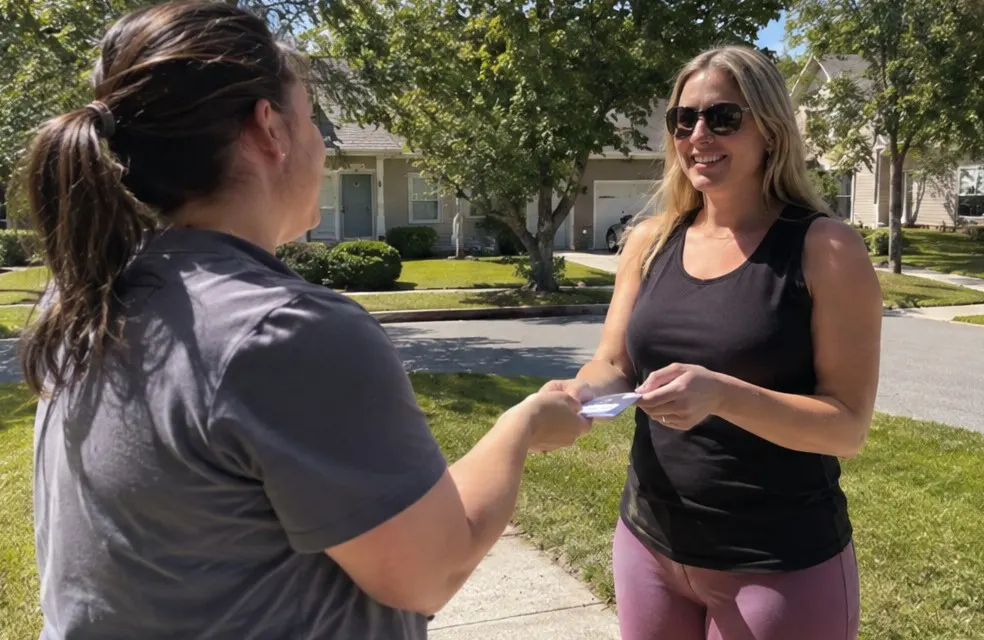
When you clean a home on a street, leave a card on the doors nearby: "We clean at your neighbor's home every other Tuesday. Biweekly cleaning from $145." Check the rule first. The U.S. Postal Service says that receptacles may be used only for matter bearing postage, so a card goes on the door handle, never in the mailbox. Check your city's rules on leaflets too.
On example numbers: 100 cards cost $25 to print, plus an hour to hang them. If they bring 2 calls and 1 recurring client, that client cost you $25 plus an hour. That is far under $243.
9. Speak your clients' language
In Miami, Houston, Newark or Boston, many homeowners prefer Spanish or Portuguese, and many speak only English. A website and a phone line that work in all three languages open doors your competitors miss. If you speak Spanish or Portuguese yourself, say so on your profile and your site. If English is your second language, a receptionist that answers English calls for you means you never lose a client over it.
Keep a simple scoreboard
Every month, write one line for each source: what you spent, the leads, the clients who stayed.
| Source | Spent | Leads | Recurring clients | Cost per client |
|---|---|---|---|---|
| Referral credits | $75 | 4 | 3 | $25 |
| Google Maps | $0 | 12 | 5 | $0 |
| Lead site | $400 | 20 | 2 | $200 |
| Door hangers | $25 | 3 | 1 | $25 |
These rows are an example. Your numbers will tell you where to put the next dollar and which source to drop. Compare each cost per client with your limit.
What to skip
- Shared lead sites without a written price per lead. You cannot judge a cost you were not told.
- Cutting prices to win. Clients you win on price leave on price.
- Paid ads before your website shows prices. You will pay for clicks that leave.
- Fake reviews, bought or written by you. The FTC rule above, and Google's own policy, make this a risk to the business.
Your first 30 days
- Week 1: Complete your Business Profile. Hide your address. Put your prices on a page.
- Week 2: Text every client who has had three cleanings. Offer the referral credit.
- Week 3: Count your missed calls and set up a way to answer them.
- Week 4: Visit three real estate offices and hang cards on one street. Start the scoreboard.
Where MaidPilot fits
MaidPilot gives you a website on your own .com with your prices and a calculator by bedrooms, an AI receptionist that answers calls in English, Spanish and Portuguese, missed-call text-back, and an automatic Google review request after every cleaning. It brings you the lead; it does not pay for ads or promise a number of clients. You can see your site free before you decide. Our guide to cleaning business software compares what the public pricing pages say.
Frequently asked questions
What is the fastest way to get house cleaning clients?
Ask current clients for referrals, complete your Google Business Profile, show prices on your website and answer every call within minutes.
Are lead sites worth it for a cleaning business?
It depends on the price per lead and how many leads become recurring clients. Ask the site in writing what a lead costs in your town and how many companies get the same request, then divide by your close rate. The guide shows the sum.